
Great Britain
Constitutional Monarchy
Maritime Empire: trade income +15%, naval upkeep −15%, research +5%.

Terminal Empire is a turn-based grand-strategy game that lives entirely in your terminal. Pick from nine playable 18th-century nations, run an economy, build villages, research a tech tree, fight wars, and reform your government — all rendered in a TUI accelerated by libghostty.
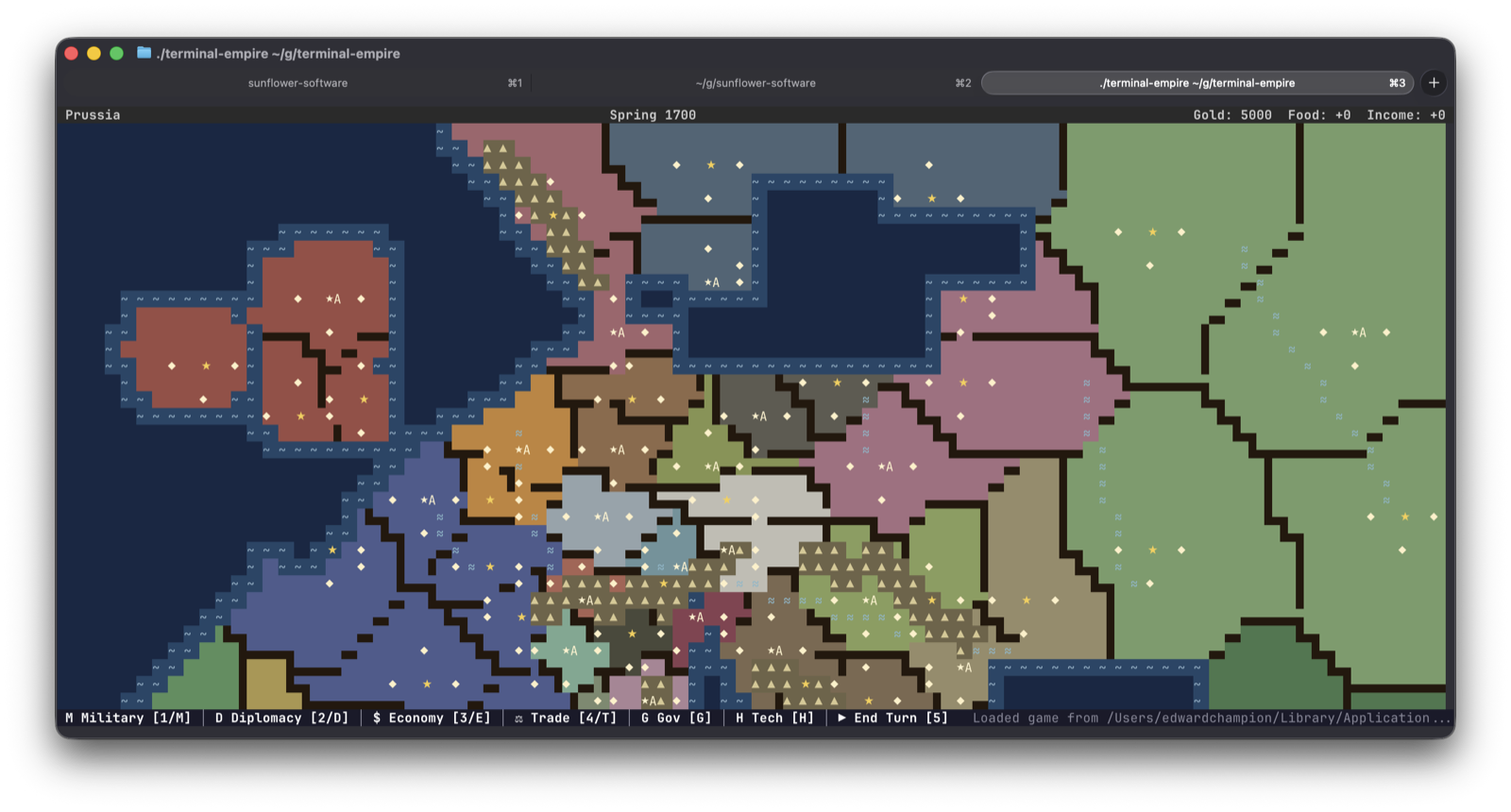
No graphics card. No launcher. No 80 GB install. Just a TUI the size of your terminal window — the same one you already have open for work.
Every playable nation ships with a national quirk — passive modifiers to tax, trade, attack, defense, or research. Prussia drills harder. Britain trades cheaper. The United Provinces research faster but bleed gold on upkeep.
Villages (Farms, Fishing Ports, Plantations, Smithies, Universities, Churches, Trading Ports) fill your territory's three village slots. Government buildings, roads, and tech modifiers stack on top of base tax income.
Raise armies, recruit land or naval units, move through adjacent territories with movement points, and auto-resolve combat against enemy armies. Generals earn battle experience and grow stronger.
Move from Absolute Monarchy to Constitutional Monarchy or a Republic. Fill your cabinet — Head of State, Finance, Military, Naval, Justice — to unlock modifiers. Quell unrest before it costs you provinces.
================================
 (*)  TERMINAL EMPIRE  (*)
A low-fidelity campaign table, lit by torch and ledger.
================================
> [N] New Game — Choose from 9 playable nations.
[C] Continue Latest Save — Prussia · Spring 1700 · 2026-05-16 12:56
[L] Load Save Game — 1 save(s) in ~/Library/Application Support/…
[Q] Quit — Leave the empire to gather dust.
Standard saves: ~/Library/Application Support/terminal-empire/saves
Each playable nation comes with its own government, treasury, starting territories, and a national quirk that subtly rewrites the numbers underneath the whole game. There is no "best" faction — only the one that matches how you want to play.
Constitutional Monarchy
Maritime Empire: trade income +15%, naval upkeep −15%, research +5%.
Absolute Monarchy
Centralized State: tax income +10%, recruitment costs −5%, happiness −2.
Absolute Monarchy
Treasure Fleets: tax +5%, trade +10%, research −5%.
Republic
Merchant Republic: trade +25%, research +10%, army upkeep +5%.
Absolute Monarchy
Drilled Army: attack +10%, upkeep −10%, trade income −5%.
Absolute Monarchy
Imperial Bureaucracy: tax +5%, happiness +4, recruitment +5%.
Absolute Monarchy
Northern Resolve: defense +10%, happiness +2, growth −5%.
Absolute Monarchy
Vast Frontier: growth +10%, recruitment −5%, research −5%.
Absolute Monarchy
Janissary Corps: attack +5%, defense +5%, trade income −5%.
Real subsystems, with real numbers — not a tech demo. Every screenshot below is the actual game, running, with no post-processing.
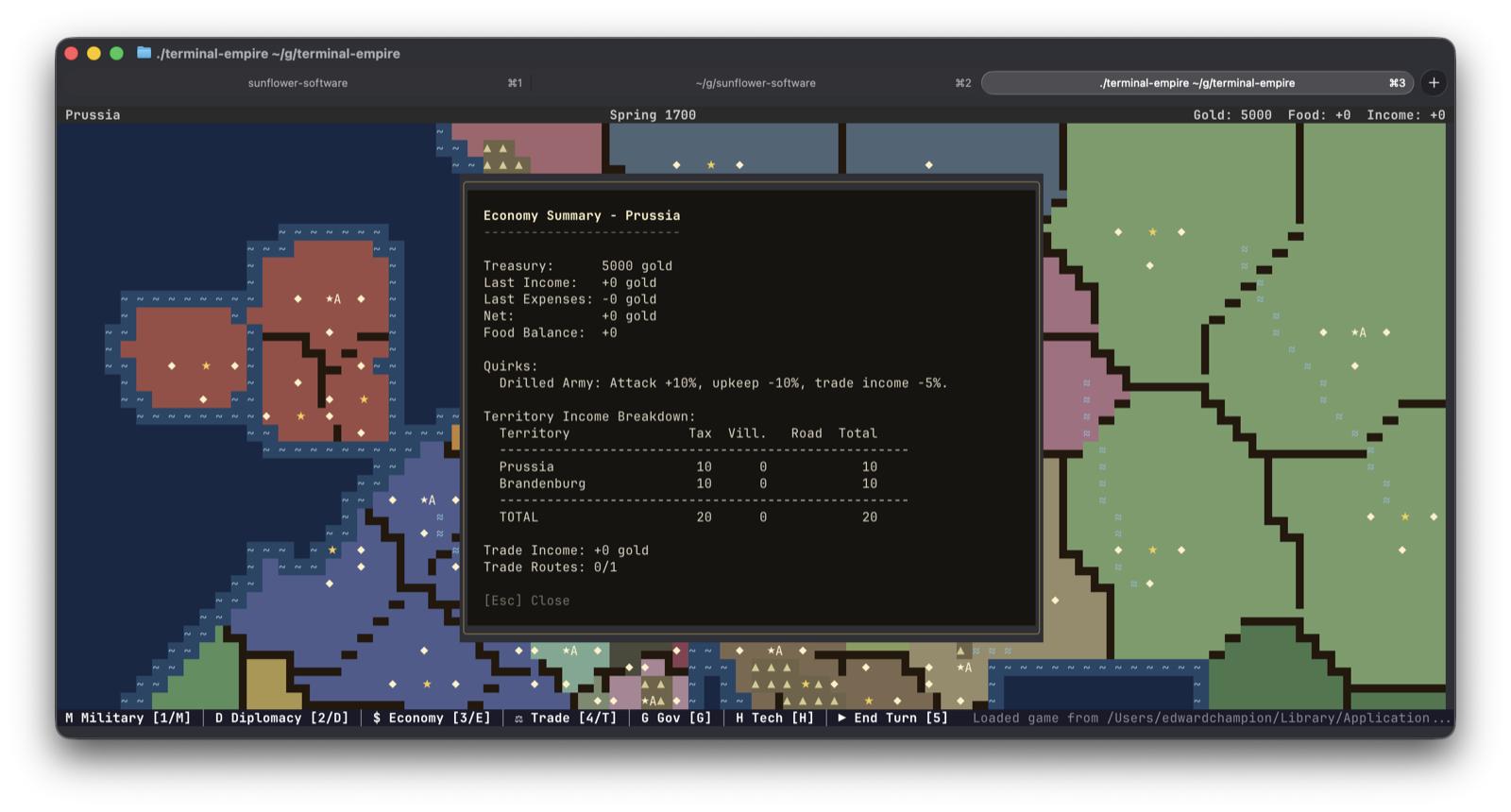
Taxes, village income, road bonuses, trade routes, and quirky multipliers from your government and tech tree. The economy dialog breaks your income down by territory, so you can see exactly which duchy is paying for your army.
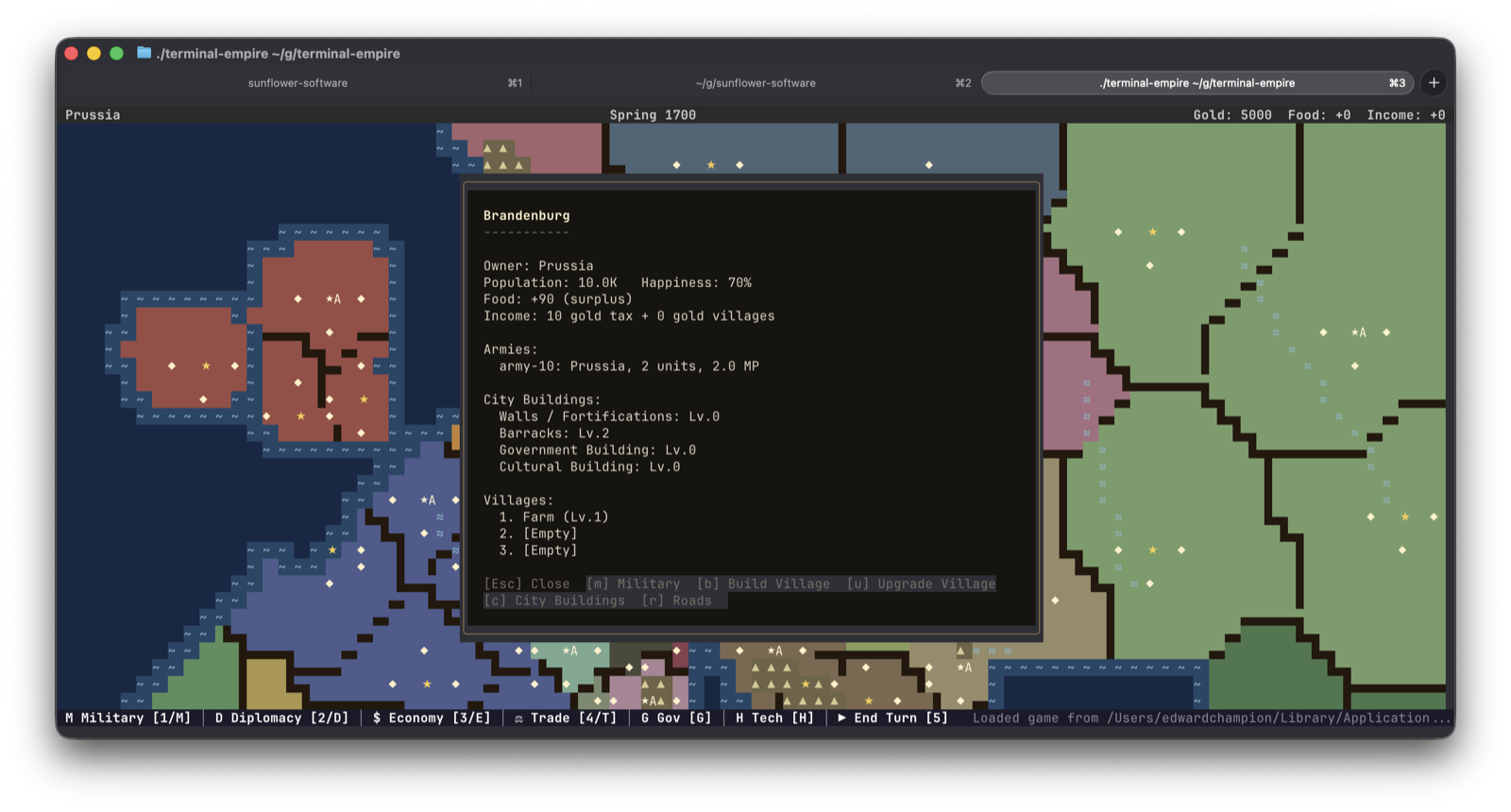
Every owned territory has population, happiness, food balance, income, three
village slots, and four city-building slots. Press Enter on a territory
to open it, then B to build, U to upgrade, C
for city buildings, or R to lay roads.
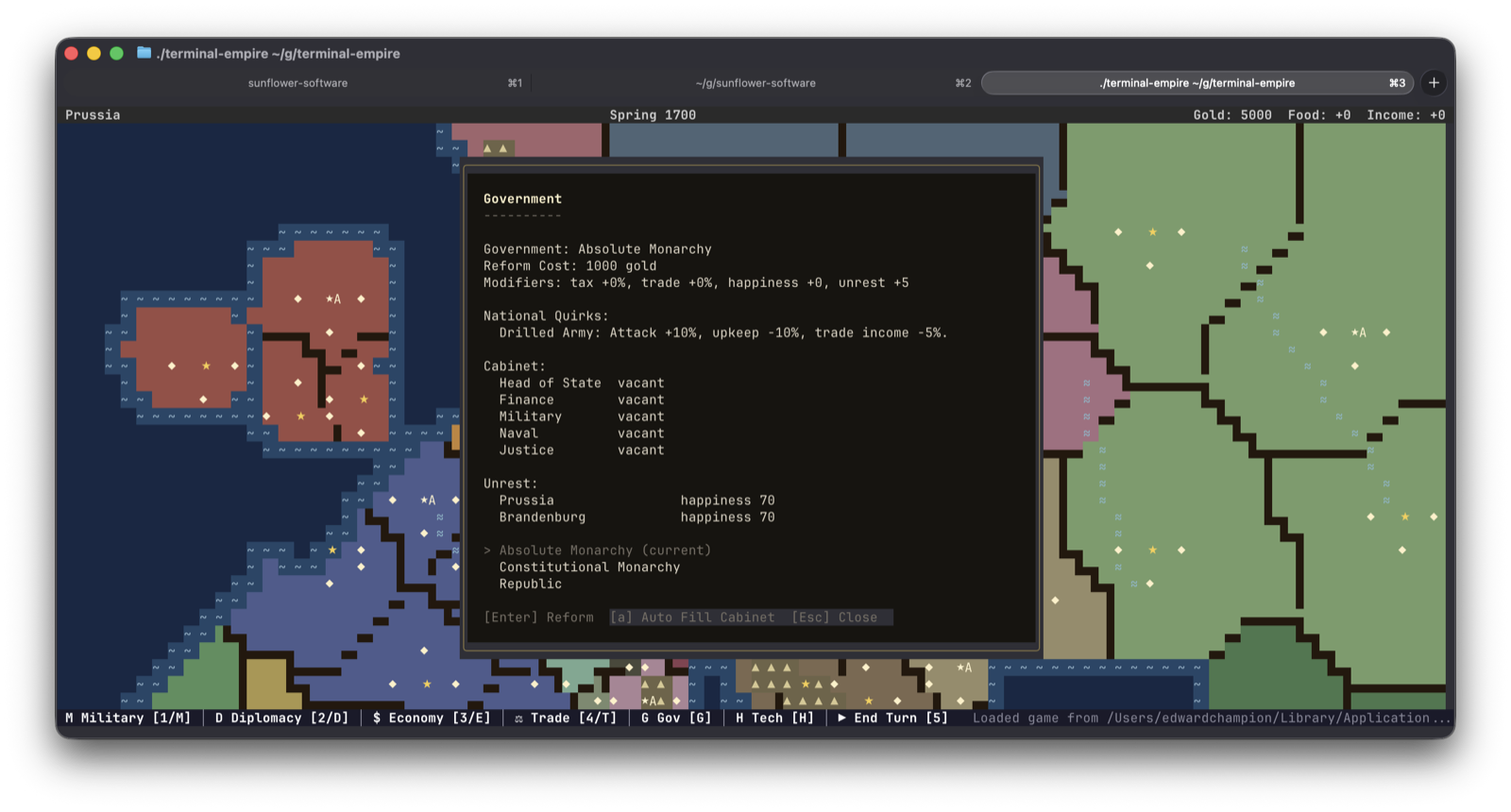
Reform your government from Absolute Monarchy → Constitutional Monarchy → Republic. Each tier costs gold and changes your modifier profile. Fill the cabinet — Head of State, Finance, Military, Naval, Justice — and watch the modifiers (and the unrest) tick accordingly.
Terminal Empire is in active development. Register interest and we'll keep you posted on the first playable build — and the launch date.